
Configurable high-speed optical measurement
ARAMIS High Speed
Follow impact, rapid deformation and high-strain-rate events beyond the SRX recording range.
Combine high-speed cameras with digital image correlation and point tracking to measure surface strain, deformation and displacement through a fast event. Configure the cameras, image area, lighting and recording memory around the time scale and spatial detail your test needs.
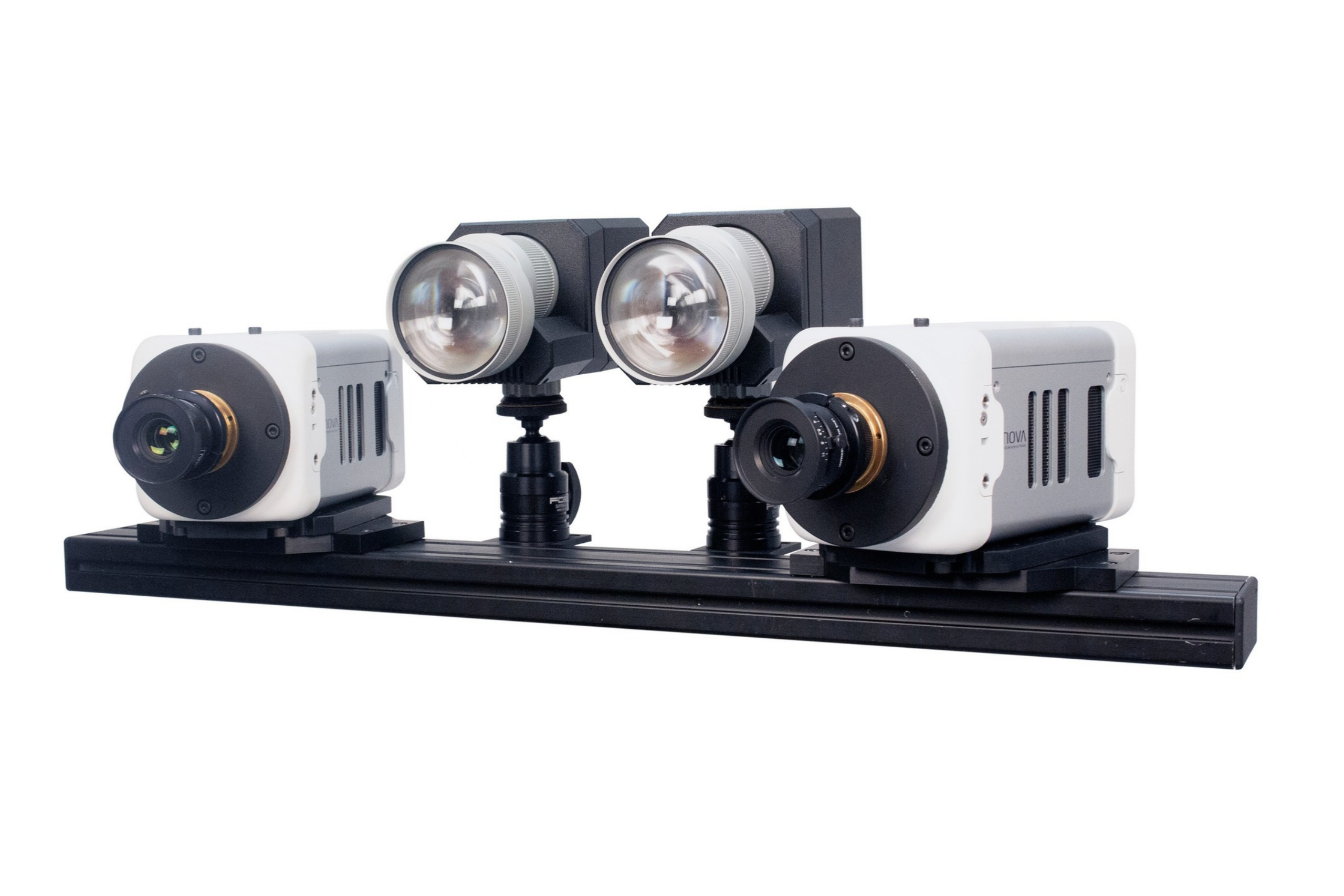
What does ARAMIS High Speed measure?
Record the visible surface of a specimen or component as it moves, bends or deforms. Stereo digital image correlation provides three-dimensional surface displacement and strain; point tracking follows selected locations or rigid-body movement. A suitable single-camera arrangement can answer controlled in-plane questions.
High Speed is a configurable camera solution, rather than a fixed SRX sensor running faster. Select a compatible camera pair around the required recording rate, image size and duration. A ballistic event, a high-strain-rate material test and a vibrating structure can require very different configurations.
An overview of the modular ARAMIS measurement approach.
Four choices that define the recording
Start with the event duration
Estimate how long the relevant behaviour lasts and how many stages are needed to follow it. A short peak may need far more temporal detail than the surrounding motion. Include pre-trigger and post-trigger requirements when defining the sequence.
Keep enough pixels on the result
Increasing frame rate often means reducing the recorded image area. The smallest cropped modes may be suitable for selected-point motion, while full-field strain needs enough visible pattern and evaluation area. Confirm the usable field of view at the selected rate.
Provide light for short exposures
Short exposure times help control motion blur but collect less light. Configure illumination, lens aperture and surface preparation together. Verify that the pattern remains measurable through the complete event, including reflections, shadows and occlusion.
Match memory to the sequence
Recording duration depends on the selected camera, onboard memory, image dimensions and acquisition rate. Plan the trigger and download workflow around the experiment. The highest frame rate alone does not define whether the sequence can be captured. More recorded images also mean more data to process after the test. Plan post-processing computing power, RAM and storage around the image size, sequence length and evaluation.
Typical high-speed DIC applications
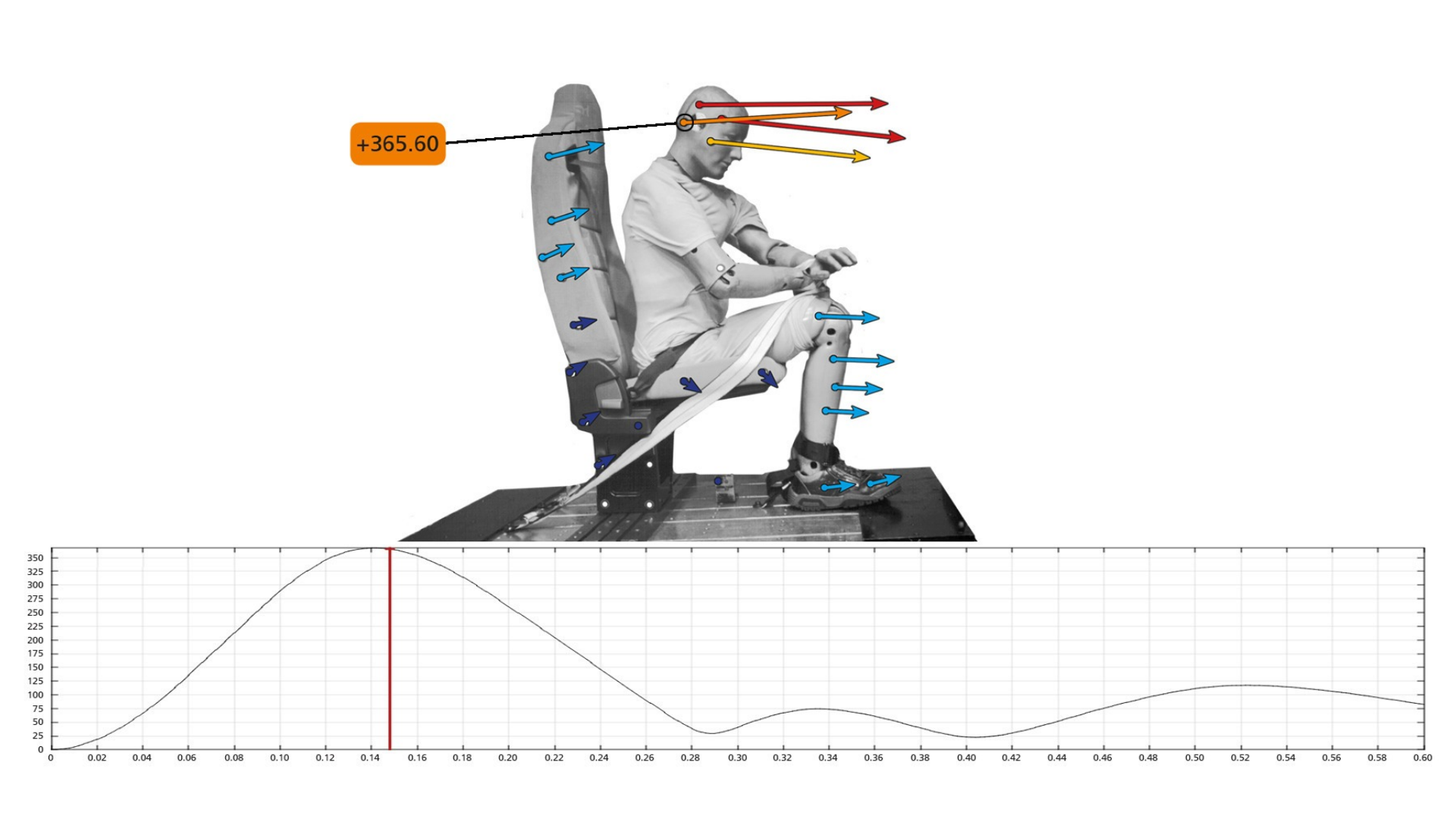
Impact, ballistic and high-strain-rate tests
Investigate the response of a specimen, panel or component during a rapid loading event. Measure the visible deformation sequence and compare the onset, peak and recovery stages with the engineering question.
Ballistic work requires appropriate optical access, protection and illumination. Select the camera configuration around the event time scale and the surface that can remain visible. DIC measures the observed surface; it does not reveal hidden internal damage by itself.
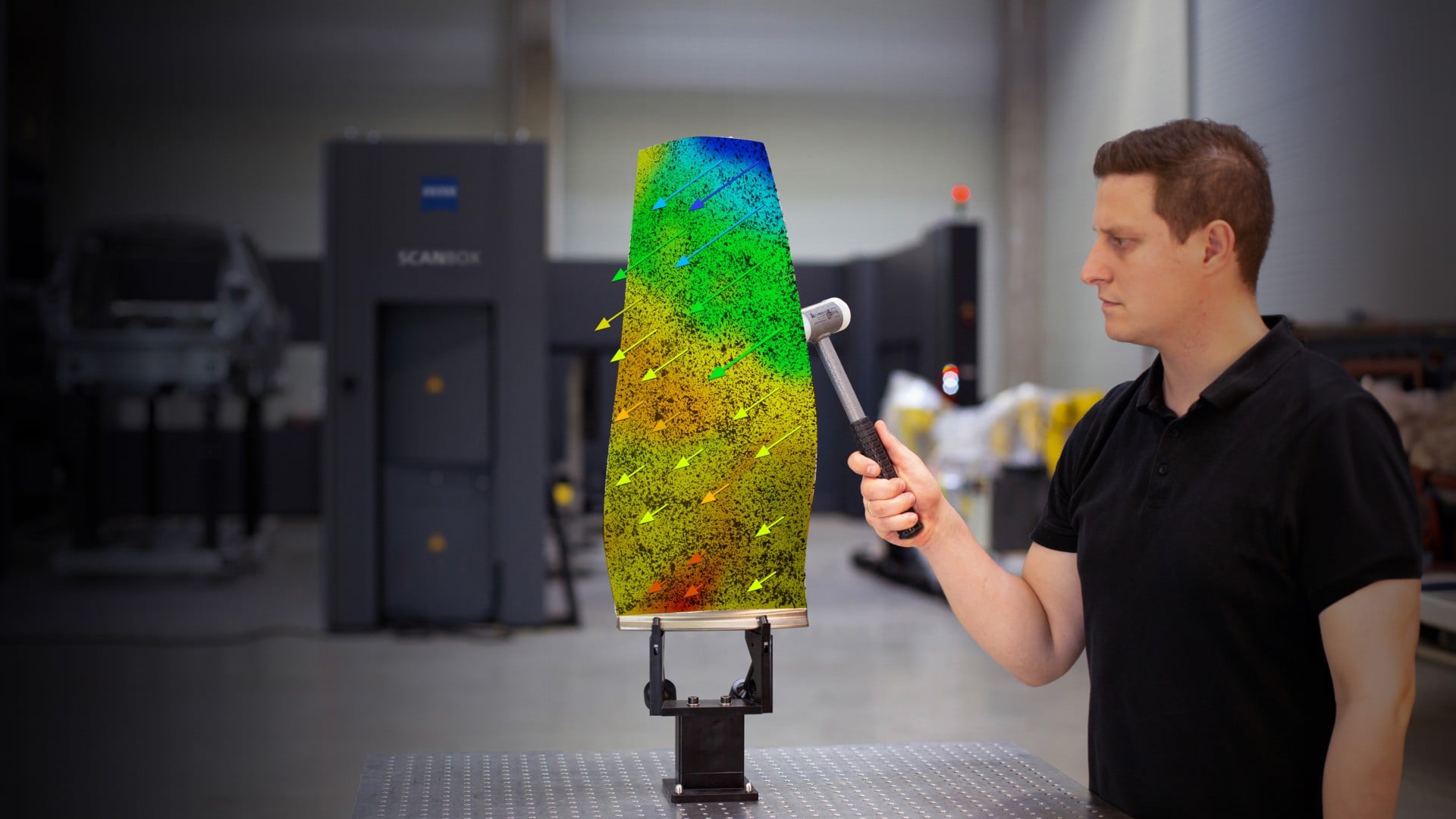
Vibration and fast component movement
Follow three-dimensional movement at selected points or across a prepared surface. Appropriate analysis can support operating-deflection and vibration investigations, including relative movement between parts.
Plan capture rate around the highest frequency and harmonics of interest. Duration also matters when resolving closely spaced frequencies. Synchronise supported external signals where the result must be related to force, excitation or another instrument.
A complete high-speed test configuration
One setup for cameras, timing and test signals
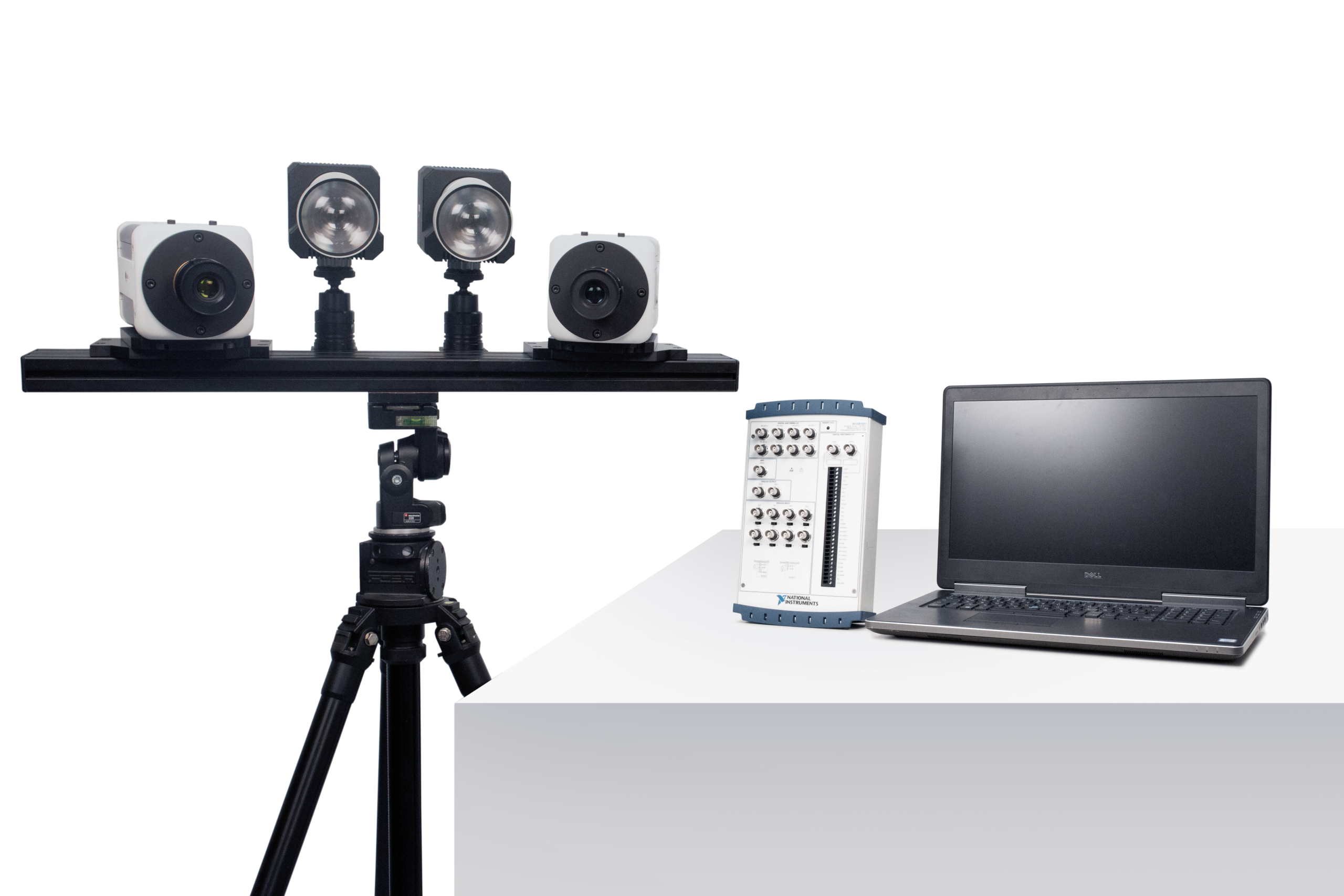
Select the cameras, optics and illumination around the measuring area, event duration and detail you need to capture. For stereo 3D, both cameras must see the evaluation area throughout the event, with calibration matched to the setup.
A vendor-specific data acquisition (DAQ) system synchronises the cameras and test equipment. Multiple inputs and outputs can coordinate triggers and supported signals such as force or excitation, so the images can be related to the loading history.
Delta XD helps define the recording window, memory, signal channels and timing. We can also assess your existing cameras and DAQ equipment as part of the proposed solution.
The camera, DAQ, laptop and illumination shown illustrate a possible configuration. Hardware, software and post-processing requirements are specified for your application.
Measurement and analysis software
Evaluate the test in CORRELATE
Turn the recorded sequence into displacement, strain and movement results. Review the full field, place virtual extensometers and relate local behaviour to the stages of the test.
Choose the licence around your data, analysis and reporting workflow. ARAMIS acquisition requirements are configured alongside the sensor.
Explore CORRELATE software and licences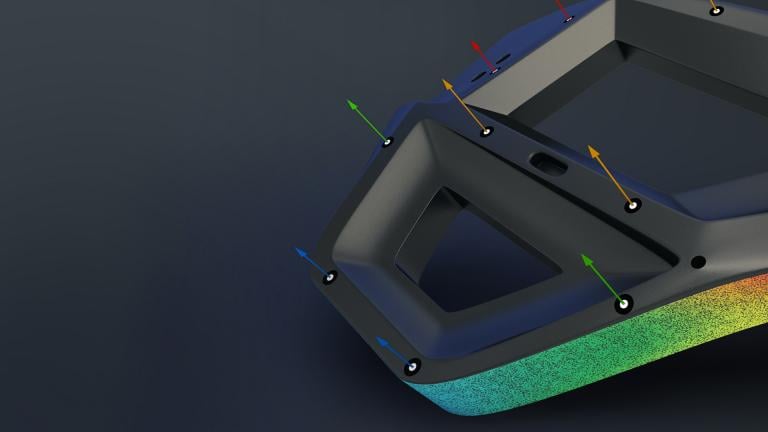
Entry-level evaluation
CORRELATE Free
Non-parametric evaluation of 2D images and videos for DIC, point tracking and reporting, with mesh and basic CAD imports. Combined with an ARAMIS system and sensor driver, it is CORRELATE Essential Line.
Repeatable commercial analysis
CORRELATE Pro
Record evaluation steps and their dependencies in a parametric project. Reuse project templates, customise reports, work with supported native CAD formats and extend analysis through apps, Python scripting and supported data exports.
Academic and research use
CORRELATE Education
The analysis functionality of CORRELATE Pro for eligible academic and research users, exclusively for non-commercial work. Discuss institutional eligibility and the intended research activity with Delta XD when requesting a licence.
Advanced ARAMIS acquisition
CORRELATE Pro Line
Add supported live tracking, ring-buffer acquisition and triggering from external signals such as force. Pro Line also supports an optically tracked touch probe and adapters. Acquisition functions, sensor compatibility and accessories are configured separately.
Education is restricted to eligible non-commercial academic and research use. Pro Line acquisition, touch probes and hardware options are specified separately; they are not implied by an Education or Pro analysis licence.
Example ARAMIS High Speed recording configurations
These are two example camera configurations from the product one-pager. They are alternatives, not selectable performance levels of every High Speed system.
| Image size | Example configuration A | Example configuration B |
|---|---|---|
| 1024 × 1024 pixels · full frame | 6,400 fps | 18,750 fps |
| 256 × 256 pixels | 64,000 fps | 165,000 fps |
| 128 × 128 pixels | 160,000 fps | 375,000 fps |
| 128 × 16 pixels · 8:1 crop | 800,000 fps | 1,100,000 fps |
| Example measuring-area range | 15 × 15 mm to 5000 × 5000 mm across different configurations | |
Recording at up to one million frames per second requires suitable cameras and a very small reduced image area. The example 1,100,000 fps mode uses 128 × 16 pixels, not the full 1024 × 1024 image. Confirm whether the remaining pixels and visible pattern support your intended DIC or point-tracking evaluation.
When is High Speed the next step?
If your event can be measured within 2,000 fps and the available image area, compare ARAMIS Adjustable SRX. Its 8 GB camera-memory option provides 335 fps at full resolution and up to 2,000 fps at 4096 × 480 pixels.
Choose High Speed when the required temporal detail exceeds the SRX range. For fine spatial detail at lower acquisition rates, consider Adjustable 24M. Let the event, required image area and recording duration guide the choice.
ARAMIS High Speed questions, answered
Does ARAMIS High Speed record one million fps at full resolution?
No. Selected camera configurations offer up to one million fps using a very small cropped image. The one-pager example reaches 1,100,000 fps at 128 × 16 pixels, while that example camera records 18,750 fps at 1024 × 1024 pixels. Choose the mode around the quantity and surface area to be evaluated.
Is High Speed an upgrade to the SRX recording mode?
It is a separately configured high-speed camera solution. SRX uses its own camera and memory modes, with up to 2,000 fps at a cropped 4096 × 480 image. Moving beyond that range may require different cameras, lighting, optics, timing and recording hardware.
Can I use it for ballistic testing?
A suitable configuration can support optical measurements of visible surfaces during ballistic or rapid impact events. Define the event duration, movement, expected surface condition, optical protection and required field of view before selecting the hardware.
Can 3D DIC measure vibration?
Yes. Stereo DIC and point tracking measure displacement over time. About ten captures per vibration cycle is a useful starting point: 100 Hz vibration suggests approximately 1,000 fps. Higher harmonics, exposure time, recording duration and the analysis method can require a different capture strategy.
How long can a high-speed event be recorded?
Duration depends on camera memory, rate, image dimensions and recording mode. Ask for a duration calculation for the exact camera configuration and include any required pre-trigger stages. Do not infer recording time from frame rate alone.
Which high-speed camera manufacturers can you work with?
Our example visuals use Photron high-speed cameras. We also have working relationships with AMETEK Phantom and other camera manufacturers. We work with each client on a case-by-case basis to determine the right solution for the test, including assessing whether your existing cameras can be used. Compatibility, synchronisation, calibration and the required image data are confirmed for the proposed configuration.
What should I send with an enquiry?
Provide specimen size, measuring area, event duration, maximum movement, expected strain, trigger source and the smallest feature you need to resolve. Include required outputs and available optical access. A drawing or short existing video helps define a practical arrangement.
Configured for your application
Request a quotation for your High Speed test
Every ARAMIS High Speed solution is quoted on a case-by-case basis. The camera choice, recording rate, image area, sequence duration and test environment define the system.
Tell us about your test and any cameras or acquisition equipment you already have. We will work with you to define the optical measurement, synchronisation, software and post-processing requirements.
Send us your measurement requirements
Use the enquiry form below to describe the application, required outputs and recording window. Include available camera models and memory capacity if you would like us to assess an existing setup.
Request a tailored quotationProduct and software information
ARAMIS High Speed downloads
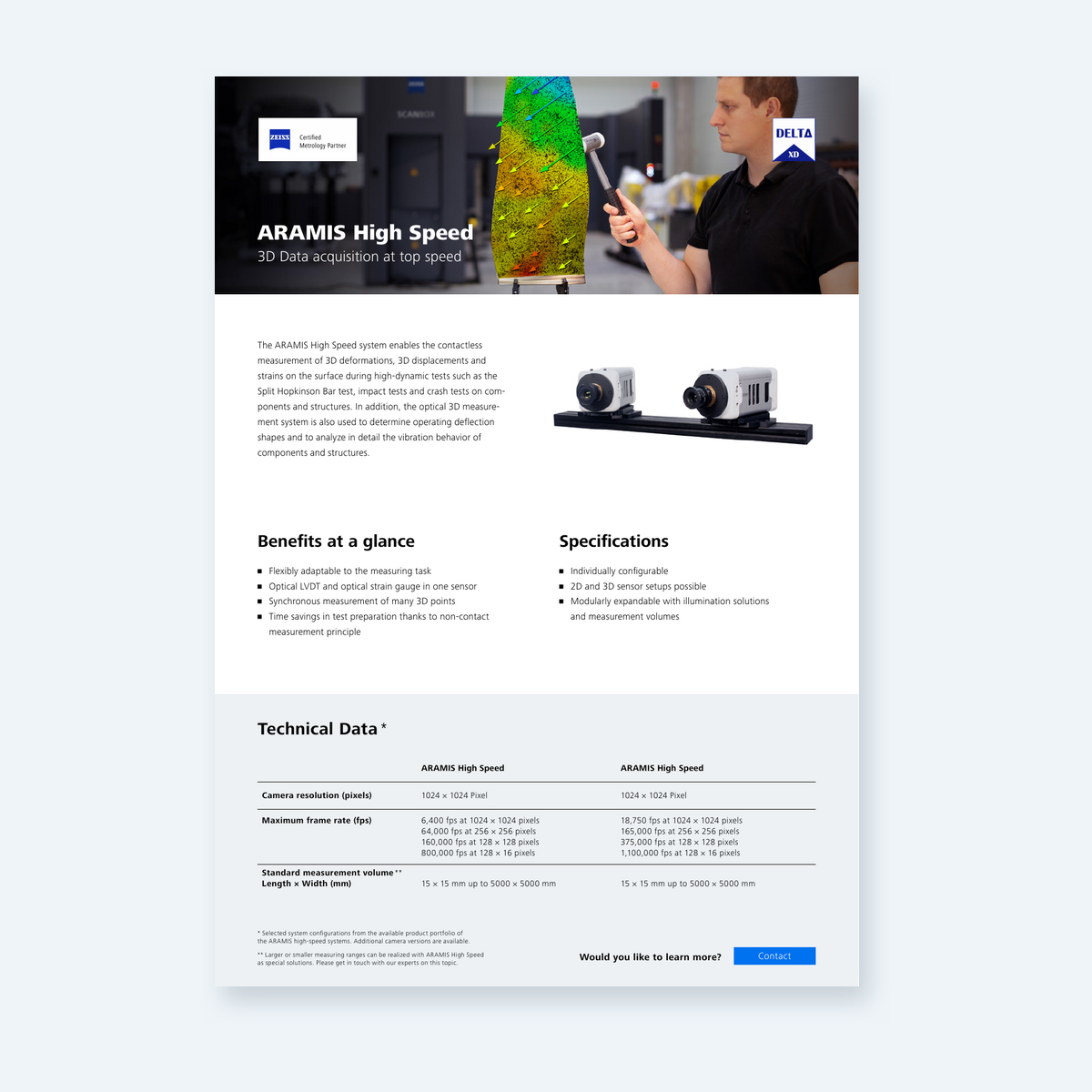
ARAMIS High Speed one-pager
Selected camera configurations, frame rates, reduced image sizes and measuring-area specifications.
Download PDF →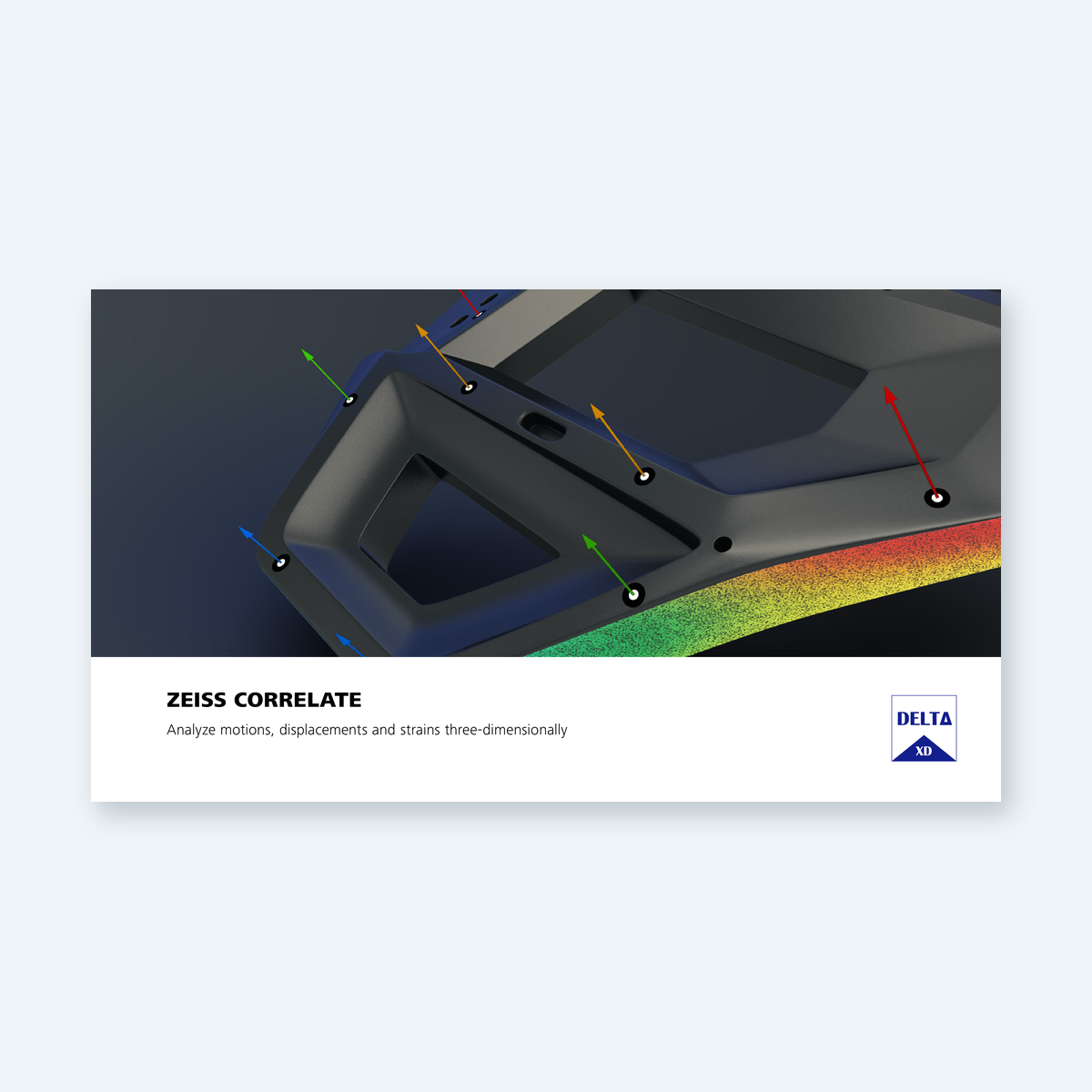
CORRELATE software factsheet
Measurement, evaluation and reporting capabilities for optical testing workflows.
Download PDF →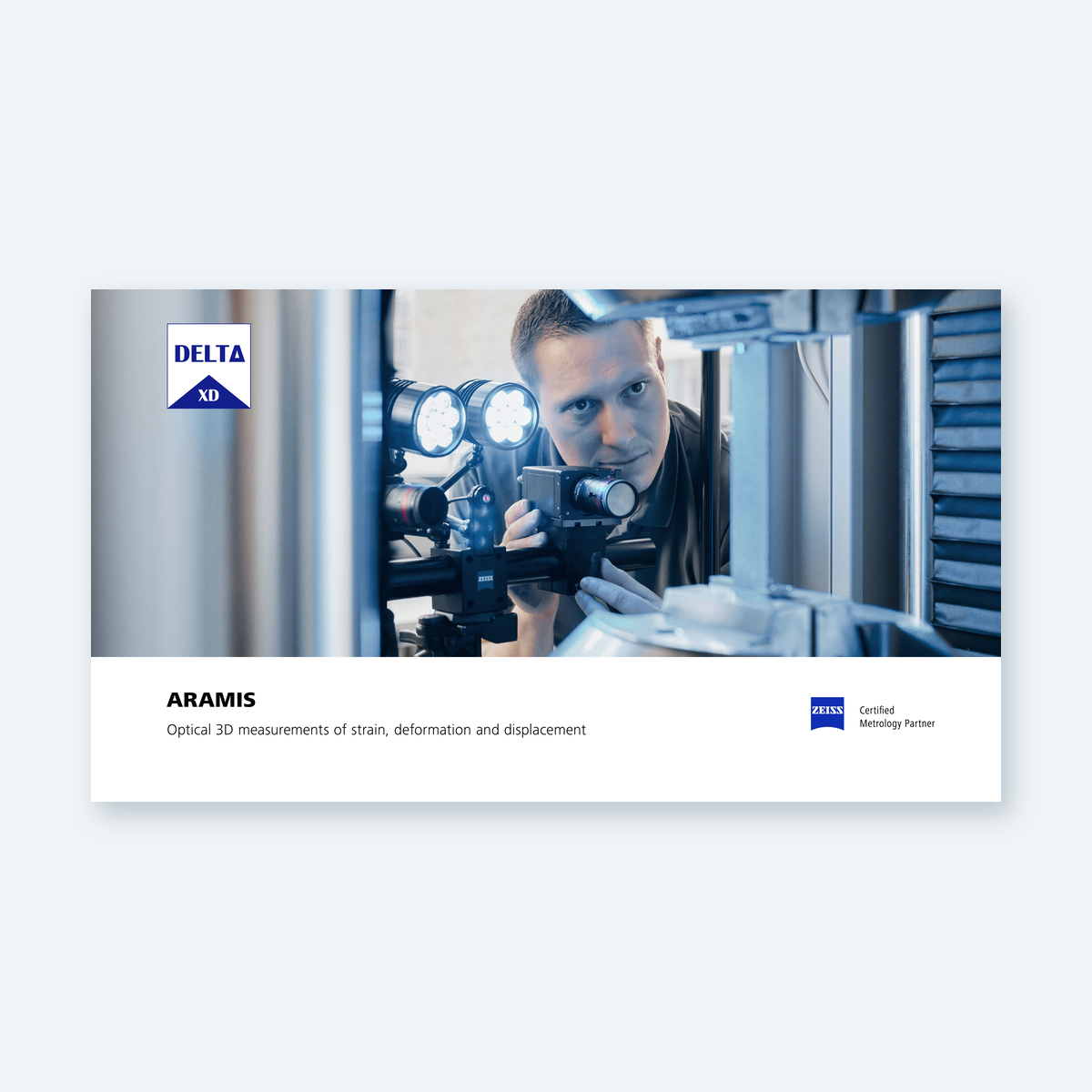
ARAMIS product brochure
Explore the wider range of optical strain and deformation measurement systems.
Download PDF →Talk to Delta XD
Tell us what you need to measure
Ask for an ARAMIS High Speed quotation, discuss a demonstration or review the setup for a planned materials or component test.
Include the specimen size, measuring area, event duration, trigger source and required recording window. Tell us about any existing high-speed cameras or DAQ equipment. These details help us recommend the optics, illumination, synchronisation and post-processing arrangement.
