
In optical metrology, reference markers play a fundamental role in how measurement systems orient the geometry in front of them.
Most 3D scanning and Digital Image Correlation (DIC) systems rely on circular reference point markers — typically a white centre with a high-contrast black outline. This strong contrast makes them easy for image processing algorithms to detect in photos or video and calculate the centre position of the ellipse, which can then be triangulated in 3D.
The software searches for shapes matching an ellipse and then applies quality criteria to confirm whether the detected feature is a valid optical tracking marker rather than noise. Once validated, the marker becomes a stable reference target that can be tracked through 3D space, across multiple camera views, or over time during dynamic testing.
Although they look simple, the optical behaviour of markers has a direct impact on measurement performance. In practice, optical metrology systems typically rely on two main types of 3D scanning markers:
- Monochromatic (plain, black and white) reference markers
- Retro-reflective markers
The choice between them influences measurement precision, acquisition speed, lighting requirements, and the quality of the ellipse detected during processing.
Monochromatic Reference Markers

5.0mm plain, black and white reference point markers from Delta XD
Monochromatic, or commonly referred to as “plain” or “black and white” markers are typically precision-printed adhesive targets made from paper or thin polymer films. When illuminated, light scatters diffusely from their surface, much like any normal material.
Their key advantage is the very sharp contrast edge between the black outer ring and white centre and high roundness tolerance. This produces a clean and well-defined ellipse in the captured image, allowing the software to calculate the marker centre with extremely high precision.
Because the ellipse edges are crisp and stable, the centre point calculation becomes very reliable. This directly contributes to high metrological sensitivity and measurement accuracy.

3.0mm reference point under the microscope showing edge quality
Retro-Reflective Markers
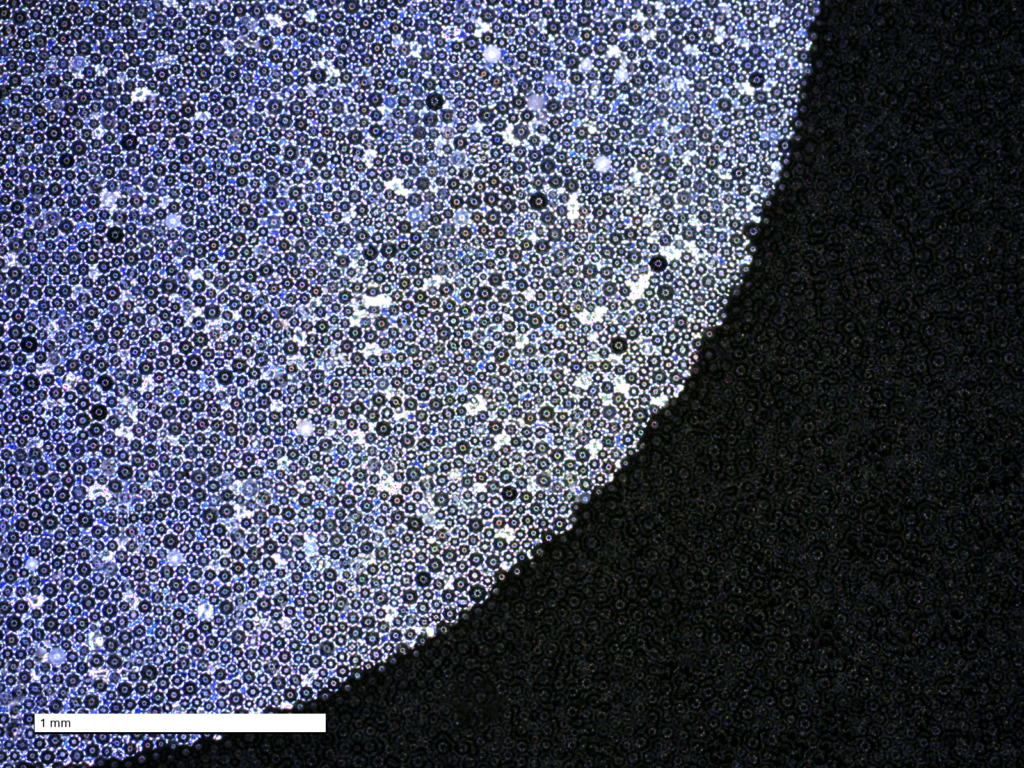
6.0mm retro-reflective reference point under the lens
Instead of relying on a printed white centre, they contain microscopic glass spheres embedded within the material. These spheres exploit the physics of retroreflection, meaning incoming light is reflected almost directly back toward its source.
When a light source is positioned close to the camera direction, the marker appears extremely bright in the image. This allows the system to reliably detect markers even under lower lighting conditions and faster shutter speeds.
This behaviour offers several advantages:
- Lower lighting requirements
- Faster data acquisition
- Reduced motion blur
- Large volume tracking
However, retro-reflective markers introduce an important trade-off. Because the reflected light travels almost directly back to the source, the effective observation angle is smaller than with plain markers. As the camera moves further away from the marker’s normal viewing direction, the reflected signal decreases quickly.
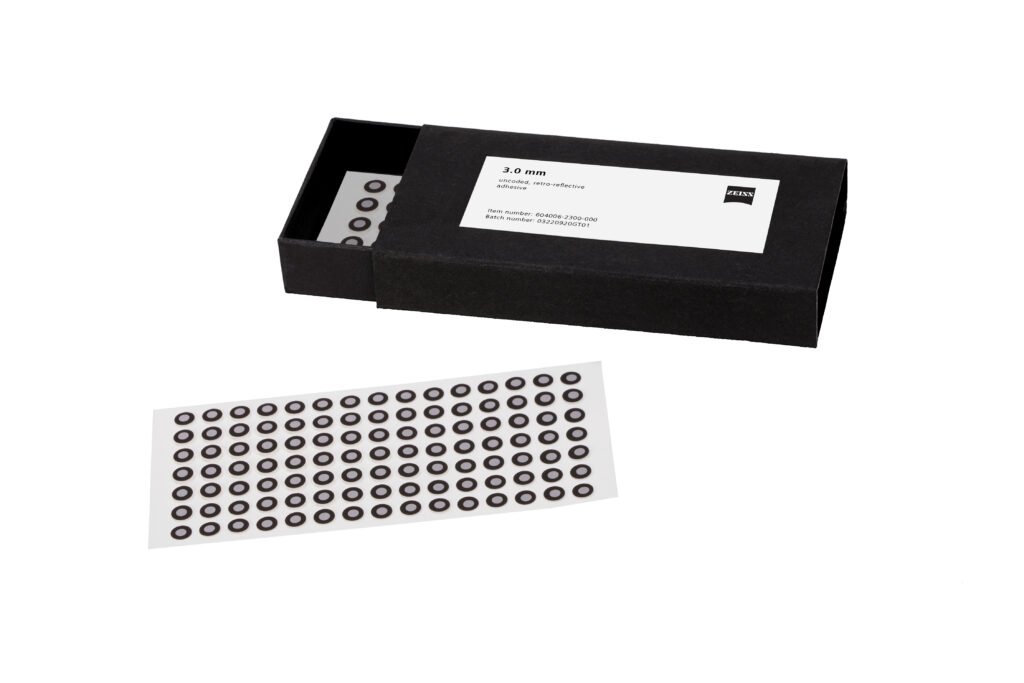
3.0mm retro-reflective markers from ZEISS
In practical terms, this means markers can become harder to detect at shallower viewing angles away from the marker centre. monochromatic markers remain visible over a wider range of observation angles due to their diffuse light scattering.
Retro-reflective markers can also produce slightly softer ellipse edges in the image compared with printed markers. While still highly effective for tracking, this can reduce the theoretical precision of the ellipse centre calculation compared with the precise boundaries produced by plain markers.
Speed vs Sensitivity — Choosing the Right Marker
Selecting the right optical tracking marker often comes down to balancing measurement precision, sensitivity and acquisition speed.
monochromatic reference markers generally deliver the highest geometric precision, thanks to their clean ellipse detection and strong contrast. They may be the better option when:
- Precision measurements
- Lighting can be optimised
- Maximum measurement fidelity is required
Retro-reflective markers prioritise speed and robustness, enabling systems to operate with lower lighting levels and faster shutter speeds. This makes them particularly suitable for:
- Dynamic testing
- Handheld scanning
- High-speed tracking of moving objects
Ultimately, the quality of the ellipse detected in the image determines how accurately the marker centre can be calculated. The marker type therefore directly affects the quality of the measurement data used in the processing pipeline.
Where This Appears in Real Measurement Systems
These principles are visible across modern optical measurement and 3D scanning technologies.
In Digital Image Correlation (DIC) systems such as ARAMIS, retro-reflective markers can support higher acquisition rates and lower lighting requirements, making them well suited to dynamic testing applications.
In structured-light scanning systems such as ATOS, plain reference markers are typically used. These systems operate in controlled environments where lighting conditions can be optimised, allowing extremely high geometric precision to be achieved.

ATOS 5 3D scanning an aircraft
Meanwhile handheld laser scanners such as the T-SCAN Hawk use retro-reflective markers to enable high shutter speed and minimise motion blur from the user. This is a major contributor to the speed and flexibility of handheld metrology systems. The resulting data quality remains very good, though the focus of the technology is rapid acquisition rather than ultimate metrological sensitivity.
Of course, markers themselves are only one component of the overall measurement chain. Camera resolution, optical quality, calibration stability, illumination strategy and software processing all contribute to the final measurement accuracy.
Markers simply provide the reference framework that allows the system to track geometry reliably.
A Small Detail That Makes a Big Difference
In optical metrology, small details often make a significant difference.
Reference point markers — whether black and white or retro-reflective — influence how well systems can balance precision, speed and measurement robustness.
While they may appear to be simple stickers, these optical metrology markers and tracking targets play a critical role in enabling accurate 3D scanning, motion tracking and DIC measurements.
Need High-Quality Reference Markers?
If you’re looking for high-quality optical metrology reference markers, we carry stock of the most common types used with ZEISS ARAMIS, ATOS and T-SCAN Hawk 2 systems. They even work with Creaform HandScan, Shining 3D, ScanTech and FARO devices too. These high-precision reference point markers and optical tracking targets will soon be available through the Delta XD online shop, making it easier to source markers for 3D scanning, Digital Image Correlation and optical measurement workflows.
In the meantime, feel free to get in touch with the Delta XD team if you need help selecting the right markers for your application.
