
Introduction
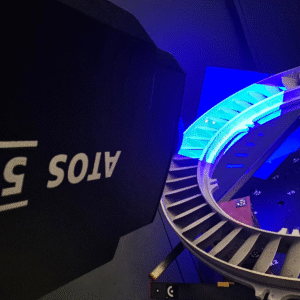
ATOS 5 Scanning of Vane Ring Assembly – The perfect combination for understanding true throat area.
In aerospace manufacturing, precision and repeatability are everything. The aerodynamic performance of turbine blades and vanes depends heavily on their geometry — and few parameters are more critical than throat area.
Traditionally, throat area analysis has been performed using 2D section-based techniques and approximation methods. While effective in their time, these approaches struggle to capture the true complexity of modern designs. Today, advanced 3D metrology tools and inspection algorithms are transforming what’s possible.
At Delta XD, we are leveraging ZEISS Inspect software and automated 3D scanning using the ZEISS ScanBox to explore the next generation of throat area analysis — the 3D throat area. This capability provides a more comprehensive, data-driven understanding of aerodynamic performance, unlocking new opportunities in both OEM production and MRO remanufacture.
From Approximation to Accuracy
Conventional 2D throat area analysis relies on section curves and simplified assumptions. This introduces limitations in precision and repeatability, as complex real-world geometries often don’t conform to the approximations used in analysis.
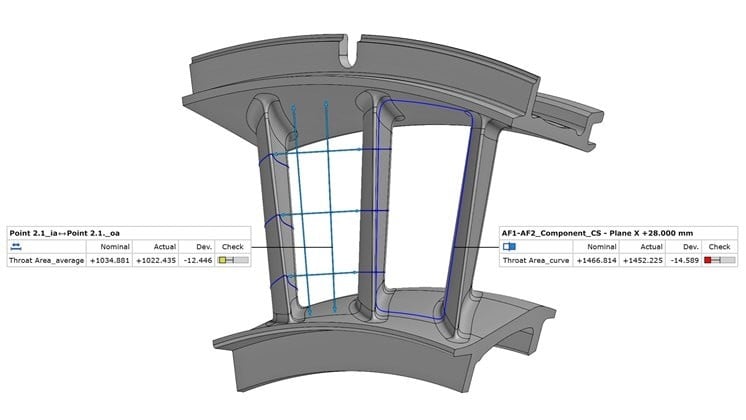
Traditional throat area constructed by sections and points. Image credit: ZEISS
The 3D throat area method, introduced in ZEISS Inspect’s Airfoil App, overcomes these constraints by evaluating the geometric equivalent of aerodynamic throat directly from full 3D measurement data.
This allows for:
-
A complete and accurate geometric representation of each passage.
-
The ability to detect subtle variations and manufacturing trends.
-
Direct correlation between geometry, aerodynamic performance, and process variation.
Advantages of 3D Throat Area
By adopting 3D throat area analysis, manufacturers and MRO specialists can move beyond measurement and towards optimisation. Key benefits include:
-
Improved correlation and understanding – Analyse real 3D geometry to gain clearer insight into how manufacturing variation affects aerodynamic behaviour.
-
Ability to tweak, refine and balance performance – Adjust individual vanes or blades to optimise flow distribution across a stage.
-
Enhanced MRO and remanufacture capability – Rebuild and rework vane rings more effectively by referencing true 3D throat area data.
-
Potential for improved engine efficiency – Use high-fidelity data to inform design refinements and operational decisions.
This evolution in inspection doesn’t just add precision — it enables data-driven engineering decisions that directly influence performance and efficiency.
Visualisation and Reporting
3D throat area analysis offers more than measurement — it delivers intuitive visualisation of the aerodynamic throat geometry across the full vane or blade surface.
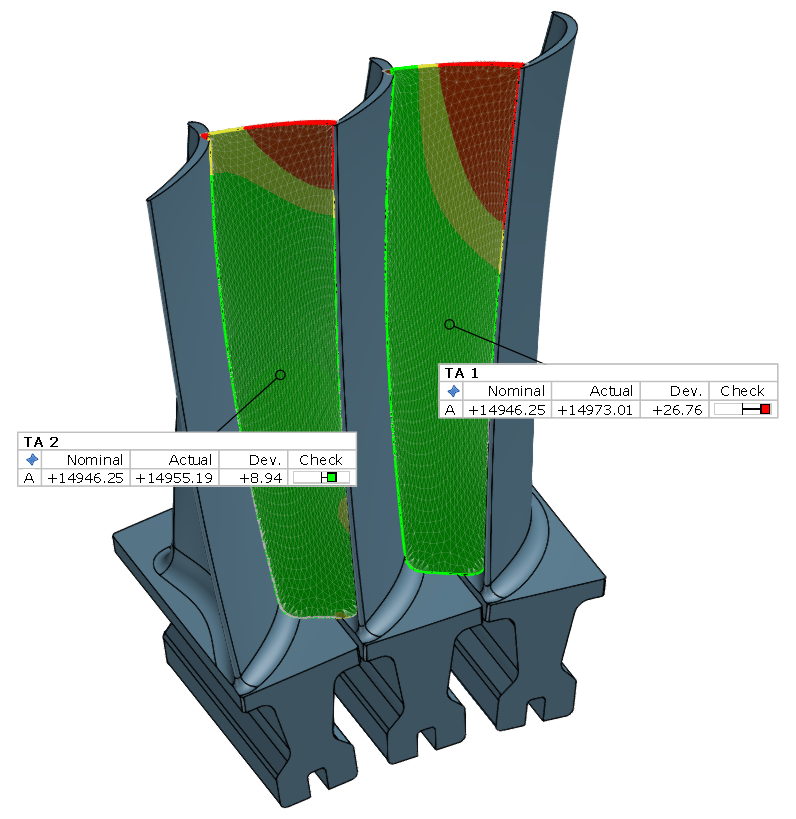
Seeing the 3D analysis of Throat area will be crucial in identifying manufacturing trends and engine performance gains/losses. Photo credit: ZEISS Tech Guide
By leveraging powerful graphical tools within ZEISS Inspect, engineers can visualise how throat area varies, identify flow imbalances, and communicate findings effectively. Automated reporting enables easy sharing of these insights across design, production, and quality teams, enhancing collaboration and traceability.
Future-Proofing Blade and Vane Inspection
As the aerospace industry continues to evolve, so too must its inspection and quality assurance processes. 3D throat area analysis represents a significant step forward — one that aligns perfectly with the industry’s move toward digital twins, closed-loop manufacturing, and data-driven optimisation.
For OEMs, this means tighter process control and improved product performance. For MRO facilities, it provides the ability to rebuild vane rings and stages with precision, restoring aerodynamic balance during remanufacture.
Conclusion
The adoption of 3D throat area analysis within ZEISS Inspect and ScanBox automation redefines how throat area is understood, measured, and optimised.
By shifting from 2D approximation to true 3D geometry, manufacturers and service providers gain the ability to:
-
Quantify variation with far greater precision.
-
Link geometry directly to aerodynamic behaviour.
-
Make informed, data-driven decisions that improve quality and efficiency.
At Delta XD, we are actively exploring and applying this technology to support our customers in both new production and MRO environments — helping them achieve measurable improvements in performance and process capability.
